

Photo from Instagram account: Collages Féministes Montréal
This text was written collaboratively by: Stéphanie Bossé, Co-Manager at Percolab Coop and DrPH candidate, and Dr. David Kaiser, public health physician and scientific advisor at Percolab Coop.
Action to end violence against women is more than a response to a crisis: it is a process of social transformation that seeks to build inclusive, just, and resilient organizations and communities. Trauma-informed collaboration, anchored in the social determinants of health, addresses the roots of injustice and marginalization. Founded on empathy, dialogue, and inclusion, it offers a concrete approach to strengthening community resilience and tackling health inequities.
In the context of increasing social crises and inequalities in safety, access to healthcare, housing, education, economic conditions, and the underrepresentation of women in decision-making spaces, trauma-informed collaboration is an essential tool for organizations and leaders committed to addressing social inequities; an approach that creates inclusive environments that support everyone, particularly those most affected by systemic inequities.
Promoting Well-Being
What is health and well-being? The World Health Organization (WHO) defines health as “a state of complete physical, mental, and social well-being, and not merely the absence of disease or infirmity.”
Within our organizations, as leaders and agents of change, our commitment must go beyond achieving performance objectives. It must extend to defending rights, fighting inequities, and creating healthy environments for everyone. Shouldn’t organizational performance be based on indicators of well-being, solidarity, and community resilience?
Why do low-income households experience more residential instability and why are they more exposed to noise and air pollution? Why are tenants twice as likely to live in housing that is too hot in summer or too cold in winter? Why do single mothers experience food insecurity at twice the rate of the general population?
These inequities are not the result of bad luck or random chance. They stem from our choices, current and past. Our living environments, institutional systems, policies, laws, and regulations have been built—both consciously and unconsciously—to exclude. Recognizing this allows us to make new choices and initiate systemic transformations. The lens of the social determinants of health highlights that all these factors impact health and well-being, and that they are all modifiable.
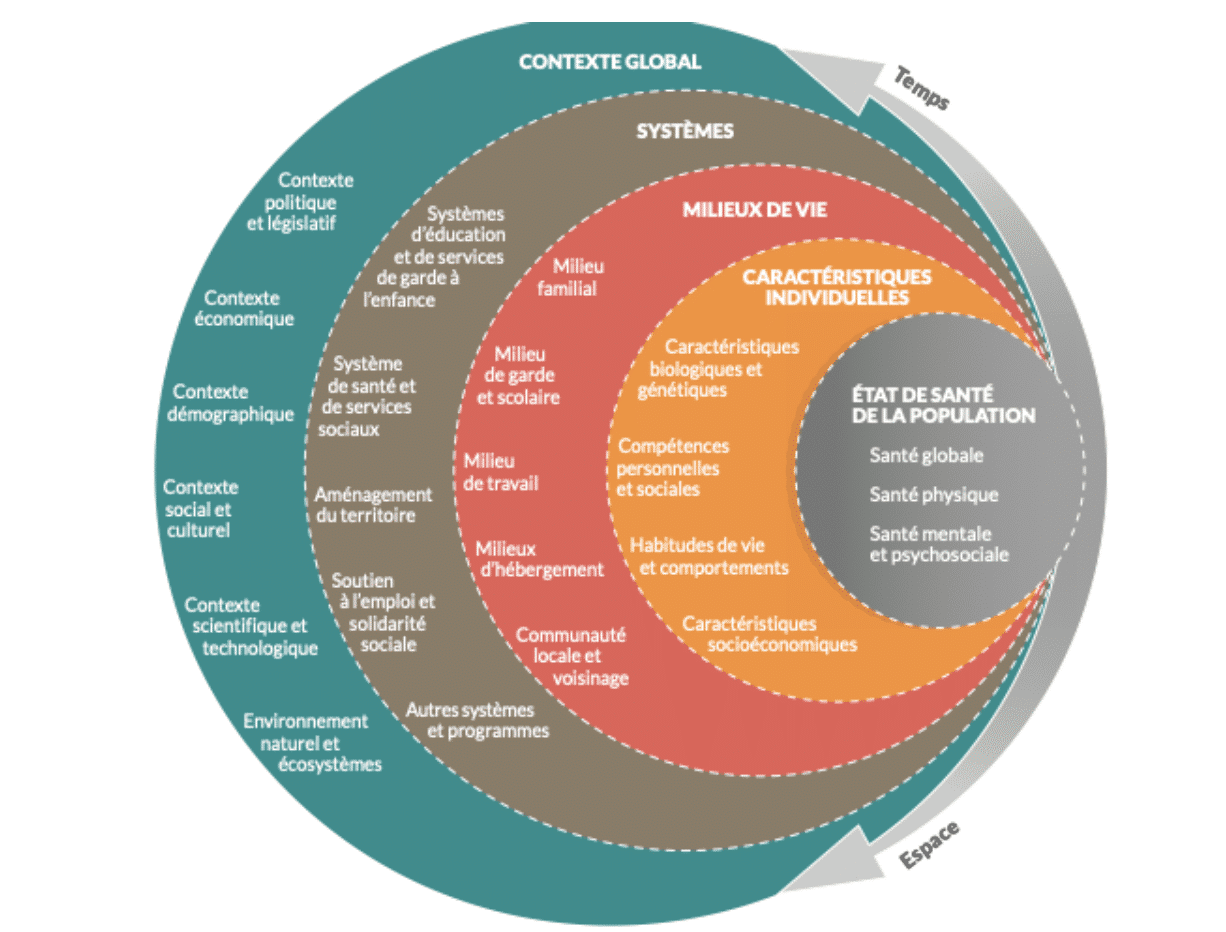
Map of Health and Its Determinants: MSSS Publication
Understanding the Scope of Trauma is Essential to Creating Thriving Environments
Many barriers persist and perpetuate inequities. One of the most widely cited definitions of trauma is from the U.S. Substance Abuse and Mental Health Services Administration (SAMHSA): “Trauma results from an event, series of events, or set of circumstances that is experienced by an individual as physically or emotionally harmful or threatening and that has lasting adverse effects on the individual’s functioning and physical, social, emotional, or spiritual well-being.”
This definition highlights the profound impact that traumatic experiences can have on an individual or a community, underscoring the necessity of trauma-informed approaches in all sectors to recognize and address them. Trauma is a public health issue that can result from systemic violence, abuse, neglect, disasters, wars—and it is pervasive.
Trauma manifests in various forms—historical, generational, or vicarious—and also occurs collectively as structural violence that prevents individuals and communities from meeting their essential needs.
Prevention – Supporting Women’s Health
A trauma-informed perspective on structural inequities leads us to pay particular attention to the health of women and girls.
Women, particularly single mothers and those from marginalized communities (racialized, having experienced complex migration trajectories, 2SLGBTQ+, Indigenous), face heightened risks in crises. These women encounter higher poverty rates linked to persistent wage gaps, bear increased caregiving responsibilities, and are more exposed to domestic violence. As sole providers for families, they are often on the front lines of precarity.
Health inequities faced by women reflect structural disparities rooted in patriarchal and racist systems that exclude them from decision-making processes and public policies that often fail to address their specific needs.
Intersecting inequities create cumulative impacts: over half of women experiencing homelessness or residential instability have reported intimate partner violence. This figure rises to 75% when considering all forms of violence, abuse, and trauma. Violence is the leading reason women seek emergency housing or shelters—a resource that remains insufficient.
Scientific knowledge about the impact of adverse childhood experiences clearly shows that stress experienced by women during the prenatal and perinatal period has life-long effects on their children. Residential instability, socioeconomic precarity, or complex migration trajectories in the first years of life contribute to physical health problems, academic difficulties, mental health issues, and violence. We now know, through the science of epigenetics, that the stress experienced by women has intergenerational impacts.
Trauma is pervasive—and closer than we think. People who have experienced trauma can benefit from emerging best practices in trauma-informed approaches.
Where to start?
Spark a cultural transformation by fostering collaborative practices and aiming for trauma-informed collaboration to create healthy and resilient environments and communities.
Collaboration is not just beneficial; it is essential – to combine our strengths, value diverse perspectives, share expertise, and develop integrated responses that address the full range of health determinants. Interdisciplinary and intersectoral work is fundamental to resilience and responding to health and climate crises, which exacerbate existing inequalities, including violence against women, for example:
- Natural disasters increase the risks of domestic and sexual violence due to stress, forced displacement, or loss of livelihoods.
- Women are often on the front lines of climate impacts through caregiving roles and service-sector work but have less access to resources and decision-making.
Organizational leaders, in the public and private sectors, have a responsibility to act at the intersection of inequities to protect the most vulnerable and foster systemic resilience.
SAMHSA outlines four key components (the 4Rs) to developing trauma-informed practice:
- Realize: the widespread impact of trauma and opportunities for healing.
- Recognize: the signs and symptoms of trauma among clients, families, staff, and others involved in the system.
- Respond: by integrating trauma knowledge into policies, procedures, and practices.
- Resist: re-traumatization by actively preventing practices that can cause further harm.
The 4R framework calls for a cultural transformation in our organisations: we cannot practice trauma-informed approaches with partners and communities if we do not adopt them within our own workplaces.
Given that one in three women experience violence, how can we take care and ensure that our organizations, educational environments and public services are free of violence for our colleagues, employees and beneficiaries?
The Six Principles of a trauma-informed approach, as defined by SAMHSA, provide an essential framework for transforming our systems and making them more equitable:
- Safety: Create environments where everyone feels physically and psychologically safe. For example by involving women and people from marginalized communities in the design of workspaces.
- Trustworthiness and Transparency: Establish relationships based on reliability, consistency and clear communication. For example by communicating when, where and how decisions are made, and who is involved in making them. By making data on salaries transparent, providing equal opportunities for women and questioning our biases.
- Peer Support: Foster support groups to build resilience, within workplaces and in communities. For example by establishing formalized mentoring programs or co-development.
- Collaboration and Mutuality: Promote cross-sector collaborations where each actor is recognized and valued for their contributions. Organizations can work with various partners to co-build inclusive and holistic solutions.
- Cultural, Historical and Gender Issues: Be aware of the cultural, historical and gender factors that influence each person’s experience, including one’s own. This means taking into account the diverse realities experienced by marginalized populations and respecting their unique perspectives when designing policies and interventions.
- Empowerment, Voice, and Choice: Provide women with the power to make choices that positively impact their health and that of their loved ones. In a trauma-informed approach, it is crucial to respect people’s autonomy and support them on their journey toward a sense of mastery and confidence.
Conclusion: Putting Solidarity into Action
By integrating these principles into our organizations and communities, we can pave the way toward a society where violence against women is no longer tolerated, and equity becomes a driver of transformation. This change begins with small, intentional actions we take today.
Key takeaways:
- Trauma-informed collaboration weaves connections across sectors, promoting individual and collective well-being to address social crises.
- The lens of trauma reveals that systemic transformation begins with working on ourselves as leaders and change agents—becoming comfortable addressing trauma for ourselves, our teams, and communities, and acquiring the scientific knowledge and skills to enhance collective capacity.
- Organizational leaders play a critical role in fostering safety, trust, and collaboration while recognizing trauma’s prevalence and actively preventing re-traumatization. Taking action means working to create a society where violence against women is no longer tolerated, and equity drives systemic transformation.
Contact us to learn more and receive support.

Mural: La 6° sphère de la culture by Dominique Desbiens. Corner of rue Lajeunesse and rue Jean-Talon, Montreal. Inspired in particular by Symbolist painters, it evokes nature and fertility (with a woman at the center), and figures illustrating the different continents.
Ressources
- Substance Abuse and Mental Health Services Administration. (2014). SAMHSA’s Concept of Trauma and Guidance for a Trauma-Informed Approach. HHS Publication No. (SMA) 14-4884. Rockville, MD: Substance Abuse and Mental Health Services Administration.
- https://proof.utoronto.ca/about-proof/
- La santé et ses déterminants : mieux comprendre pour mieux agir. Ministère de la santé et des services sociaux (2012). https://publications.msss.gouv.qc.ca/msss/fichiers/2011/11-202-06.pdf
- Le devoir, 29 novembre 2024, Les québécoise travailleront gratuitement jusqu’à la fin de l’année
- Réseau Québécois de OSBL d’’habitation https://rqoh.com/crise-du-logement-et-injustice-climatique/
- https://www.inspq.qc.ca/sites/default/files/2024-05/3486-logement-sante-cadre-conceptuel.pdf
- Regroupement des Maisons pour femmes victimes conjugales https://maisons-femmes.qc.ca/wp-content/uploads/2017/09/fascicule.pdf
- UN Women Feminist climate Justice https://drive.google.com/file/d/1op6KINaR1ehVjmIaKSk5m78HtbXbxFjI/view