
Using a Contributions Board for a healthy collective approach to accountability that builds kindness.
« It’s beautiful ! »
– Wendy, facilitator from Taiwan.
“I’m going to start doing that as soon as I get back.”
– Archana, who works for an Indian NGO.
« I’m going crazy! »
– 25-year old Mony, from Cambodia Impact Hub.
These reactions followed the discovery of the Contributions Chart. This simple tool has been a real eye-opener for many. This article explains the process.
Sometimes our teammates don’t notice everything we do. Sometimes, we ourselves don’t recognize our own value in what we accomplish. A lot of anxiety and worry can surround the question of “who does what.” Clarifying our contributions helps us feel recognized and valued. It can reveal blind spots and support capacity building. Let’s explore the three steps of the Contributions Chart together. You’ll see how stress around responsibilities transforms into appreciation for contributions.
📌 Step 1 : Identify the areas of work
To begin, you need to make a list of the different types of work accomplished. Every project is different. For example, for a training our contribution items might include:
- Promote the event
- Take care of finances
- Registrations
- Food and venue
- Design the days
- Facilitation
Another type of project might include other work areas, such as client relations. Everything is contextual.
Beforehand, someone lists all the work areas on a grid with a column for each person. You can do this on paper, a whiteboard, a spreadsheet, or whatever is your preference. Plan some time to check if anything is missing or to clarify any items. Don’t assume everyone understands the jargon. If a few items aren’t yet finished, that’s fine.

📌 Step 2 : Each person identifies their involvement
You need a shared language for clarifying personal contributions.
This is what we use.
Holding
Did we hold the responsibility for getting things accomplished?

Doing
Did we engage in doing the work involved?

Learning
Were we intentionally learning to do this alone in the future?
Coaching
Were we helping someone in their learning? Offering occasional advice.

Not involved
A joyful part of teamwork and trusting your team.
Each person has their own column and only they can write in it. We take a moment to connect with all we held (H), did (D), learned (L), coached (C), and where we weren’t involved (0).
For each item, we indicate our contribution with a letter or multiple letters. For example, if I was responsible for registrations and I did the work, and I coached others I would put “HDC” next to this item. If I did some translations when people asked me to do it, without holding the translation responsibility, I would put a “D” next to that item. If I was supporting others to document, without doing it myself, I would put “C”. For any area I was not involved in I put an “X”. It’s as simple as that.

Sometimes it can feel like your involvement was a light touch and a full letter would be too much. For example, if I gave a hand with registrations for a few hours over the full 3-month registration process. A small “d” could be helpful to communicate that.
It helps to complete the board in silence, so each person can figure out for themselves what they did and didn’t do.
📌 Step 3 : Adjustments and insights
Once completed, we sit back and look at the board. We have an opportunity to challenge each other. If I saw you Holding the responsibility for designing the event and you didn’t put an “H” for yourself, I can share that. If you think I was in learning mode around promotion, and I didn’t state it, you should let me know. Seeing our contribution isn’t always easy, and it feels quite kind when someone else notices our work.
Finally, once the items are all settled, we take a collective scan of the board to see what we are noticing.
I usually ask 3 questions.
- Is there an item that no one is Holding?
- Is there a healthy amount of Learning and Coaching?
- Is there any other pattern that we are noticing?
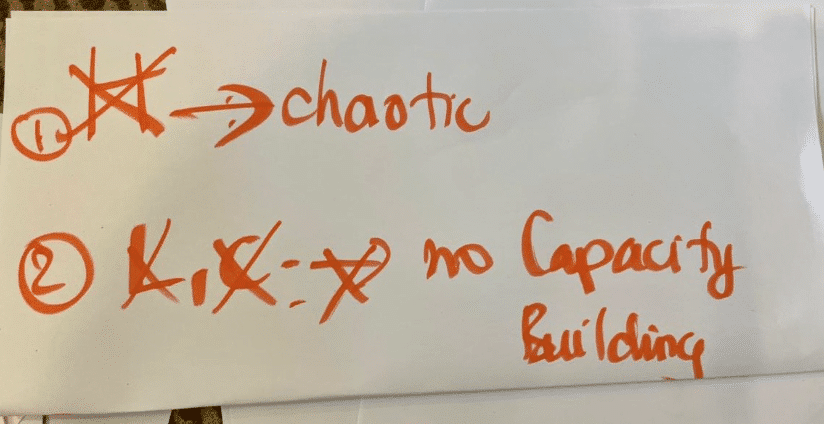
This can spur some deeper learning from the group. Remember, things are never perfect. When a work area struggles with confusion, or a lack of quality, it might be because no one was Holding. Every part of the work requires some Holding.
Also, Learning goes deeper when there is a clear agreement with a Coach. Ideally all Learning goes with someone Coaching. My colleague Thao shared her insight after a collective reflection on a contributions board: “I feel nudged and inspired to be more of an intentional learner and ask for help from the team .”
Personally, the Contributions Board has helped me to think about my role in capacity development. When I see that I am able to Hold something I should begin to think about how I might support and coach others in this area. Building capacity is what it’s all about. A Contributions Board can help us to be in collective continuous improvement.
Put the steps to practice
So there you have it, 3 simple steps to clarify who did what in a way that helps us support each other and learn together. Try it out. Play with it. Be attentive to how you bring kindness to it and how it grows kindness in others. Our relationships are the foundation of a healthy work culture.
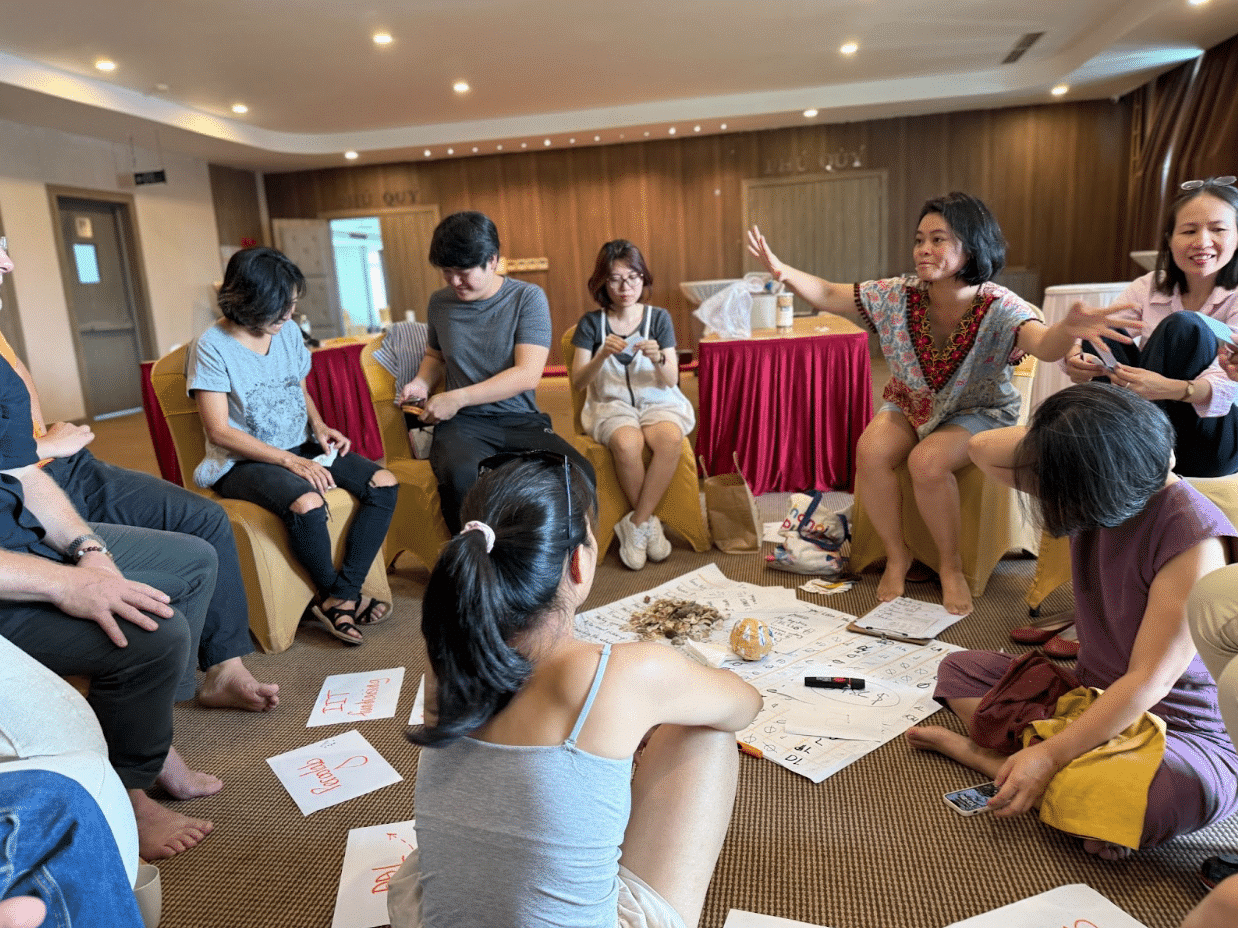
The Contribution Board has shifted the energy of this group at an Art of Hosting in Vietnam.
This process was created by Percolab, an applied research lab on ways of working, learning and governing. As with most developments at Percolab, it is inspired by a deeper lineage of working together that goes back thousands of years.
Written by Samantha Slade
