
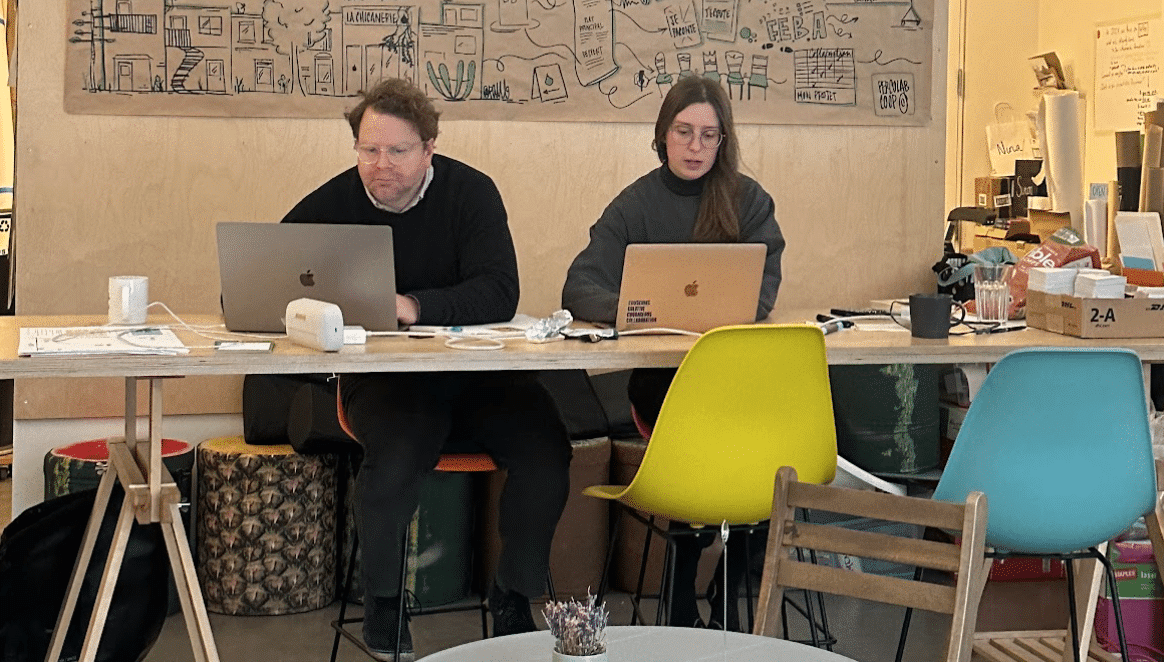
Photo: Paul and Olivia work side by side on separate tasks, creating an environment of shared focus.
Body doubling is a peer support strategy where one person completes a task in the presence of another, without necessarily interacting. This simple presence can improve concentration, reduce anxiety, and encourage engagement in the activity.
This practice, particularly suited to supporting individuals with concentration difficulties (such as Attention Deficit Hyperactivity Disorder, also known as ADHD), is based on the principles of shared attention and implicit social accountability. The presence of a compassionate witness makes the task feel less daunting or anxiety-inducing. Furthermore, when approached through a trauma-informed lens, body doubling leverages co-regulation* to mitigate stress responses and encourage action within a climate of safety.
Co-regulation helps expand the window of tolerance by providing a sense of security and support. The window of tolerance is a concept developed by Daniel J. Siegel to describe the optimal state in which a person can function in a regulated manner, responding to challenges with flexibility and resilience. When we are within this zone, our nervous system is balanced, allowing us to think clearly, make decisions, and interact with others in a healthy way. Through trauma-informed practices and principles that foster well-being and shared responsibility among colleagues, our workplaces can become spaces where trauma responses* are part of a normalized vocabulary and contribute to overall health.
Concrete Examples of Requests and Offers for Body Doubling Support
SUPPORT Requests |
SUPPORT OFFERS |
| Can we schedule a check-in at 8:30 AM tomorrow so you can help me get started on my day? I have a long to-do list and worry that I’ll find a thousand distractions before sitting down at my computer. 👉 | I want to make sure you take time for lunch. |
| Making this call to my bank feels overwhelming—could you be present with me while I do it? 👉 | You’re under a lot of stress these days, I’m going to make sure you take a proper lunch break today. We can have a moment together. |
| I need to post an update on my LinkedIn profile about my upcoming event. Can you be with me while I write it to make it less intimidating? 👉 | I can be there while you work on this difficult task/project, even if I am doing something else at the same time. |

Photo: Olivia and Nina practice body doubling together to tackle administrative work after a workshop at La Chicanerie.
Why It Works
Creates a Psychologically Safe Environment: The presence of a colleague reduces feelings of isolation and activates the neural circuits associated with trust and social engagement.
- Makes Tedious Tasks More Enjoyable.
Body doubling facilitates taking action: The implicit support of another person helps reframe tasks and reduces the pressure we place on ourselves. The co-presence effect stimulates nervous system regulation, promotes calmness, and helps overcome inertia caused by stress or fear of failure.
- Keeps You Focused.
It normalizes challenges with kindness: supporting healthy practices for dealing with difficulties while helping individuals recognize their own limits without guilt. Everyone experiences this! Instead of doing the work for someone else, we accompany them through the process to break negative patterns.
- Uses Positive Peer Pressure for Better Performance in a Healthy Manner
In summary, body doubling can be a powerful tool for fostering healthier trauma responses in a collective setting, offering tangible support that soothes the nervous system through co-regulation. This, in turn, helps reduce maladaptive defense mechanisms and encourages positive, balanced action.
*Co-REGULATION
Co-regulation is the process by which a person regulates their emotional and physiological state through interaction with another person. It is a fundamental mechanism of human development, based on attachment and social connection, that helps soothe the nervous system in response to stress (Siegel, 2012).
- It relies on the interaction between the nervous systems of two people: A calm and regulated person can help another regain balance.
- It is central to infant development, where babies learn to manage their emotions through the soothing responses of their caregivers.
- In adults, co-regulation appears in supportive social interactions, such as peer support, psychotherapy, or teamwork in a secure environment.
*Trauma response
A trauma response is a set of physiological, emotional, and behavioral reactions triggered by a perceived threat, often rooted in a past experience of danger or intense stress.
Trauma disrupts natural stress regulation mechanisms, leading individuals to develop automatic responses such as:
- Fight: Reacting with aggression or resistance.
- Flight: Avoiding the anxiety-inducing situation.
- Freeze: Feeling paralyzed and unable to act.
- Fawn: Adapting to others’ expectations to avoid conflict or rejection.
References
- Levine, P. A. (2010). In an Unspoken Voice: How the Body Releases Trauma and Restores Goodness. North Atlantic Books.
- Porges, S. W. (2011). The Polyvagal Theory: Neurophysiological Foundations of Emotions, Attachment, Communication, and Self-Regulation. W.W. Norton & Company.
- Siegel, D. J. (2012). The Developing Mind: How Relationships and the Brain Interact to Shape Who We Are. Guilford Press.
- Van der Kolk, B. (2014). The Body Keeps the Score: Brain, Mind, and Body in the Healing of Trauma. Penguin Books.
- Villines. Z , What is Body Doubling for ADHA Medical News Today Updated on November 4, 2024—consulted february 2025 https://www.medicalnewstoday.com/articles/body-doubling-adhd